
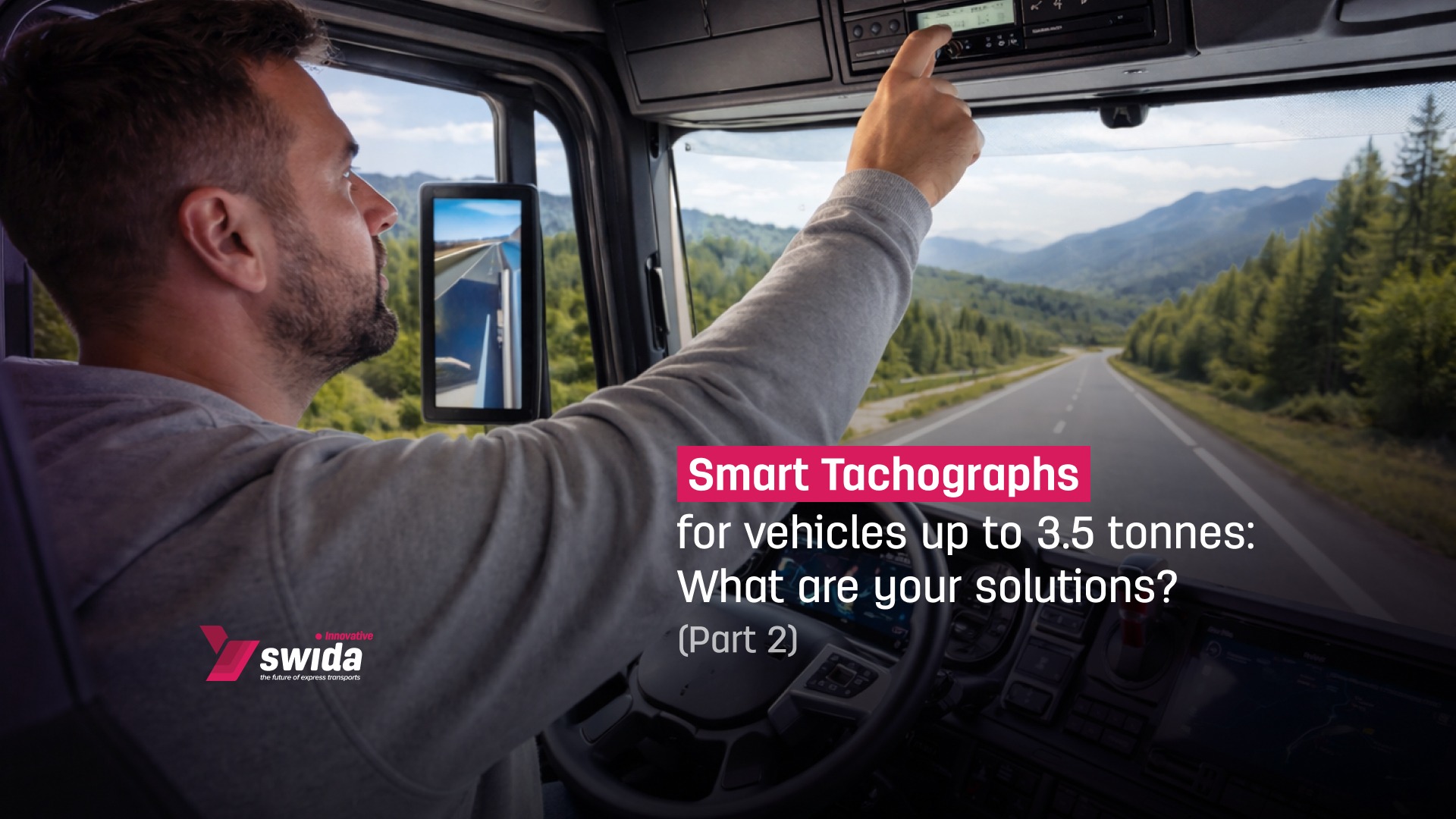
In the first part of our article, we introduced the topic of smart tachographs and outlined the reality awaiting European logistics starting July 1, 2026. Under the European legislation (the so-called Mobility Package), all vehicles with a total weight between 2.5 and 3.5 tonnes engaged in international transport will be required to use smart tachographs.
The fundamental challenge facing the market is time. By law, van drivers are subject to strict rules on mandatory safety breaks and rest periods. Express delivery, which has primarily relied on transiting Europe without major delays, will naturally see extended lead times.
At SWIDA Innovative, we aren’t just waiting around. Based on market research and data analysis, we have developed strategic solutions for our clients to keep cargo moving even after the legislative changes take effect.
When a driver is legally required to rest, we have two primary ways to maintain delivery continuity (excluding the premium capacity-limited option of using double-crew vans).
The new European regulation applies to vehicles over 2.5 tonnes. One of the simplest solutions for smaller, urgent shipments is splitting the cargo into smaller volumes. This allows the use of vehicles (e.g., pickups and small vans) with a total gross weight that does not exceed this limit.
This solution is for you if you need to transport a standard van volume but cannot afford to wait. The goods are transferred from the first van to a second one at a strategically located warehouse along the route, featuring a fresh, well-rested driver.
An interesting exception may be domestic (national) transport. However, a strict rule applies: the vehicle used must be registered in the specific country where the transport takes place.
Legislative changes always bring price adjustments. Tachographs reduce overall vehicle efficiency, and any alternative that aims to compensate for this lost time incurs increased costs. Based on current market research and carrier planning, we estimate the following price trends from 2026:
*Note: These figures are qualified estimates based on current market data. The final situation will largely depend on vehicle availability and total demand at that time.
The introduction of tachographs for vehicles up to 3.5 tonnes will change the rules of the game. At SWIDA, we pride ourselves on bringing solutions, not just problems. Thanks to our wide carrier network and advanced planning, we are ready to set up your shipments so they make sense – both in terms of time and cost.
Don’t waste time looking for solutions at the last minute – our experts will help you set up an optimal transport strategy tailored to your needs. Contact us today.


If your business regularly moves commercial samples, exhibition equipment, or professional gear across international borders, you are likely familiar…

In our previous articles, we broke down the technical side of the Mobility Package and explored the potential impact on international transport.

Yesterday was Earth Day, and here at SWIDA Innovative, we are currently in the middle of our internal “Eco Week.” Our team has been busy finding…

Stay on top of the latest transport tips, news, trends and best practises.

Reporting
To report a security incident, please send all the required information listed below to: incident@swida.sk.
Contact information: name, company, country.
Incident details:
Verification
Swida Innovative s.r.o., will analyse the reported issue. Confirmation of the incident should take a maximum of 10 days. You will then receive our statement to your email.
If the incident is recognised, Swida Innovative will analyse the cause and determine the best solution to the problem.
Disclosure
Adhere to a period of 90 days before publicly detecting this vulnerability.
Our account manager will contact
you with an offer soon.
In case of any questions, you can
contact us at +421 910 172 218.